We Couldn’t Find a Washing Machine That Fit Our Boat, So We Built One

Well, this is a first.
Normally, CleverMariner articles start with a disclaimer: we’re not paid by or affiliated with any of the companies we write about. We buy the gear, test it ourselves, and write about it because we enjoy going down these rabbit holes and sharing what we learn.
This one is different. This time, the product is ours!
The Clever Mini Washing Machine was born because I pulled my hair out trying to find a washing machine that would actually fit on Connie (SV Confianza) and that didn't use a ton of water.
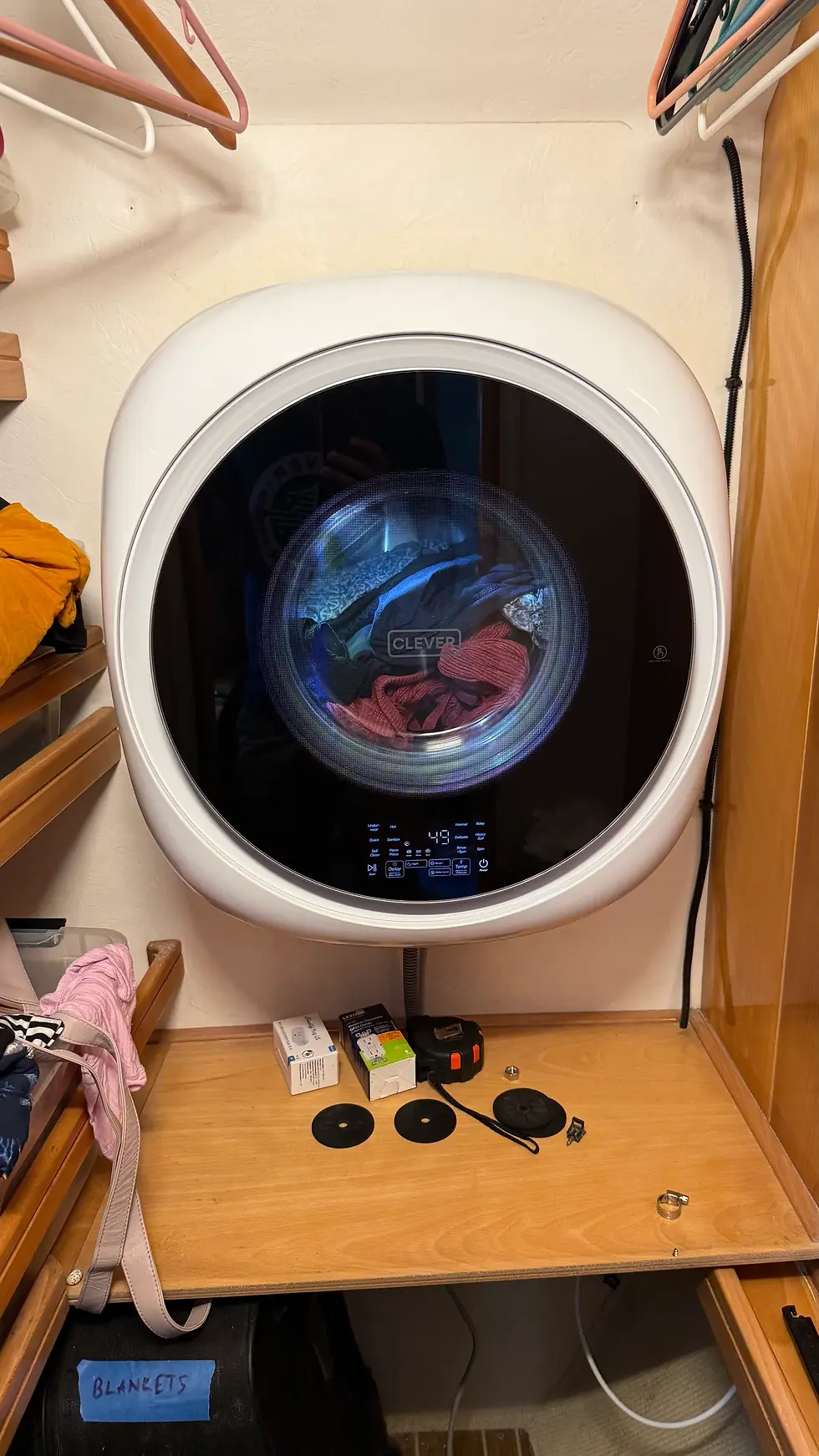
That turned out to be a surprisingly hard thing to find.
So, after searching through Daewoo / Winia minis, portable top-loaders, compact “marine” machines, imported 220V units, and questionable knockoffs, we eventually stopped looking for the right washer and started building one.
Let's look at the options that are out there and our journey to make something better.
Jump to...
Fitting a Washing Machine on a Boat
That was our problem on Connie. The boat came with a French top-loading washing machine installed in a forward closet. It was heavy, it took up nearly the entire closet, and it ran on 230V European power.
When we converted the boat to US power, the washer became a very large paperweight.
We considered keeping it and installing a dedicated Victron inverter just to run that one appliance, but that felt like a pretty expensive way to preserve an old washer we didn’t really like anyway. It was big. It was heavy. It used an entire closet. And if we were going to redesign part of the boat around laundry, we wanted the end result to be better than “the old washer works again.”
So, we pulled it out. The closet immediately became useful again.
Which was great, right up until we needed to do laundry.
The Underwear Passage
There was one passage circa 2022 where laundry went from a set of minor annoyances to straining our resolve to keep up this lifestyle.
We ran out of clean underwear on a days-long, rough passage on our way south from Maine. Co-captain Angie was feeling very defeated, as it was too rough for bucket or sink laundry. When we finally made it to a semi protected anchorage, I stayed up late washing Angie’s clothes in a bucket, hanging them out to dry at 1am with the hopes she would have a better morning.
If the boat was going to continue to be our full-time home, some basic creature comforts had to improve. That night I started a mission.
Comparison Table
Before we dig into the whole story, let’s compare the current compact washer landscape.
Model | Size (H, W, D) | Capacity | Water Usage* | Water Usage | Voltage | Weight | Price |
Clever Mini CLVR-W01 | 24.4” × 21.7” × 12.8” | 6.5 lb | 3.2 gal | 0.5 gal / lb | 120 V / 60 Hz | 39.7 lb | $1,200 |
Daewoo / Winia Mini DWC-M25CW** | 25.6” × 21.7" × 12.8” | 5.5 lb | 4 gal*** | 0.7 gal / lb | 230 V / 50 Hz | 50.7 lb | Discontinued |
BLACK+DECKER BPWM09W | 31.5" × 17.7" × 18.1" | 6.5 lb | 11 gal | 1.7 gal / lb | 120 V / 60 Hz | 44.1 lb | $279 |
Splendide WFL1300XD | 32-7/8" x 23-1/2" x 22-3/4" | 15 lb | 16 gal | 1.1 gal / lb | 120 V / 60 Hz | 148lb | $1,199 |
*Full load, most water efficient cycle
**No longer in production
***As reported by users - Not Published by manufacturer.
Note: I originally planned on adding a cheap washer from Amazon like the Auertech AU7740. However, the specs seem wildly inflated. It's a similar footprint to the Black+Decker, however claims to have 2.5x the capacity. I decided to trust the specs of the name brand and throw out the Amazon models as nonsense. Please drop a comment if you have any experience to share with any of these models.
Note 2: I was also going to include the Equator EW 828 M Washer, which is an interesting option, although too large for our use case. However, they do not publish their weight or water usage I have reached out to the manufacturer and will update the table if I receive a reply.
The Daewoo / Winia Mini Rabbit Hole
If you search for a compact washing machine, you will almost certainly find the Daewoo Mini. At first, this looked like the clear answer.
It was compact, and it was wall-mounted, which is definitely a different way to solve the weight and size issues. It looked like it could tuck into the back of the closet and leave the rest of the space usable.
At that time, there were a couple of problems, though.
The Daewoo Mini is Korean, but there were 220–240V Australian versions floating around overseas. YouTube has a bunch of folks happy with their installs, but I saw a couple of problems for us. They were often out of stock. Even when they were available, importing one raised a pile of questions I didn’t love.
The common advice was to use a cheap step-up transformer. I get why people do that. And plenty of people have gotten away with it.
However, I’m a pretty big proponent on this blog of doing marine electrical properly, so I’m not thrilled about adding a cheap transformer just to make a grey-market washing machine work.
There is also the frequency issue. A 50 Hz appliance may run on 60 Hz. Or it may not care much. Or certain parts of it may care a lot. So, we would have to be OK with a unit that is not actually rated for our AC frequency.
Then there’s the regulatory side.
In the US, clothes washers are regulated appliances. They have DoE efficiency requirements and EnergyGuide labeling requirements.
There was going to be a carve out for small washing machines, but that was scrapped by the current administration. So, the Daewoo Mini couldn’t legally be sold into the US.
I learned that Daewoo became Winia, and Winia was in a never-ending bankruptcy. They did not seem to care much about the rules after they wrapped up their US operation. And, more recently, they have ceased production on most of their products, including the Daewoo/Winia Mini.
Alright, that’s out, so what next?
The “Marine" Washing Machine Option
There are “marine” and “rv” washing machines on the market, but most of them are really just smaller European appliances sold into the marine/rv market.
Some of these are nice machines, to be fair, but they’re not actually optimized for a boat. For instance, they have a lot of dead space in the design. They’re too large to fit through most monohull companionways as well as mono/catamaran cabin doorways, so that really limits where they can be placed.
Plus, they use concrete weights for stabilization, adding a ton of unnecessary weight.
Next!
Cheap Top Loaders
We were getting desperate to find something that would work for us. I explored the Black and Decker BPWM09W and even the cheap amazon no-name brands.
The main problem with top loaders is the water usage. They have to fill the entire drum to submerge the clothes for both washing and rinsing, using double or triple the water.
Aliexpress Knock Offs of the Daewoo Mini?
I actually ordered a couple of these while we were designing our unit to help us evaluate manufacturing partners.
There were two big problems that I found.
First, quality was all over the place. Materials felt cheap. Metals were very cheap. I left the mounting bolts outside for one night, and by the morning they were covered in corrosion.

Second, they were belt driven. The motor was attached to a belt that turned the drive wheel to turn the machine.
The drive wheels were made of aluminum, so a little corrosion would lead to chewing through belts. That would be a constant battle.

Changing the Question
At some point, I realized I had put a ridiculous amount of time into trying to find this washer.
I had mapped the entire category: what existed, what didn’t, what people were importing, what RVers were using, what cruisers had successes and failures with.
The compact washer concept is much more common in Asia than it is in the US marine and RV market, which meant the manufacturing base, components, and experience already existed. Now we had to focus the design around the actual use cases for boats and RVs.
Small-space installation. 120 V / 60 Hz as well as 230V / 50 Hz. Low water use. Low practical power draw. Enough capacity to be worth using. Reasonable weight. Repairability. Parts availability.
The Clever Mini Washing Machine is Born
It took about 3 years for our team to settle on a design, a manufacturing partner, and get the first set of prototypes made. We got lots of feedback from the cruising community and rv community. It’s a market full of folks with very strong opinions ha!
Installation
The Clever Mini mounts to a bulkhead or any reinforced wall on the boat. The mounting bolts must enter from the back of the wall and are secured by nuts inside the case.

Since our bulkheads are foam core, we reinforced the back of the bulkhead by expoying a plate of Garolite—a fiberglass/epoxy composite. This prevents the thin glass layer skin over the foam from compressing/cracking. It was probably overkill, but it made me feel better.
The holes in the bulkhead are small enough that it should not provide any structural issues to the bulkhead, however, I think you can't be too careful with structural components of the boat. The Garolite plate makes this a non-issue.
The water/drain/power are routed to bottom of the unit in a channel behind the removable case

What our Typical Usage Look Like
We find ourselves using the Quick Cycle (15-min, ~3 gal water) most of the time. Since there’s only one rinse, the quick cycle is susceptible to over-soaping. We have to make sure we don’t actually add too much.
We don’t even bother to check the water tank level before doing a few loads. Our energy-recovery watermaker is very efficient, which is great, but it does not produce water very quickly. So the low water usage for the washing machine is a big benefit.
For normal summer clothes, if we hang a load on the lifelines at least four hours before sunset, it is usually dry that evening. Obviously, humidity, fabric, sun, wind, etc all are factors.
The type of clothing does matter. Lightweight summer cruising clothes pack very differently than jeans, sweatshirts, towels, or cold-weather layers. When we’re in colder climates, we do have to get in the habit of washing more frequently and in smaller loads.
I thought I would use the temperature and water-level options more than I do. I end up only fiddling with them when we’re coming off of multiple cloudy days and a low battery bank, and we need to wash something like our sheets that should use warm water.
Warm water is going to activate the enzymes in the detergent and provide a better clean, especially for something like sheets.
HE Detergent and Enzymes
Most HE detergents contain enzymes. The optimal cleaning temperature to get the most out of the enzymes is 105F. This also happens to be the default temp setting of the Normal cycle.
It’s nice to have the temp selection to still choose a cooler warm (86F vs 105F) when we’re low on batteries. We’ll still get some enzymatic action.
How Do We Like It?
Not to toot my own horn, but the Clever Mini is a fantastic washing machine for our boat.
This whole journey started because everyday things in modern life are just harder on a boat, and they started piling extra weight on us. At least one of those things has been completely removed.
Over the years we have been improving life aboard one thing at a time. Now, we have washing machine, a microwave, an air fryer, an air conditioner (for a couple hours a day), and even an ice maker—all on a solar/lithium power budget.
This means that we get to spend more time hiking to a secluded beach and less time doing chores.
Drop a comment if you’ve got any questions or feedback! And check out the Clever Mini washing machine here.


Comments